Why Tier-2 Cities Need Hyperlocal Delivery Platforms Built for Local Needs
India’s digital commerce story is no longer limited to Bengaluru, Mumbai, Delhi and other major metropolitan areas. Customers in Tier-2 cities increasingly use smartphones to order food, make payments, communicate with businesses and purchase products.
Why Tier-2 Cities Need Hyperlocal Delivery Platforms Built for Local Needs
India’s digital commerce story is no longer limited to Bengaluru, Mumbai, Delhi and other major metropolitan areas. Customers in Tier-2 cities increasingly use smartphones to order food, make payments, communicate with businesses and purchase products.
However, copying a metro delivery model into a smaller city does not automatically produce good results. Tier-2 cities have different customer behaviour, road networks, delivery densities, business structures and price expectations.
They need delivery services designed around local conditions.
Tier-2 Cities Are Not Smaller Metros
Metropolitan delivery models often depend on dense residential areas, high order volumes, dark stores and large promotional budgets. These conditions may not exist in the same form in a city such as Hubballi.
Distances between commercial and residential areas can be different. Addresses may rely heavily on local landmarks. Customers may place orders through phone calls or WhatsApp rather than a dedicated online store. Many businesses may need delivery only a few times each day instead of hundreds of times.
A suitable Tier-2 model therefore needs to work with scattered demand while keeping delivery affordable for customers and financially worthwhile for runners.
Local Commerce Extends Beyond Groceries
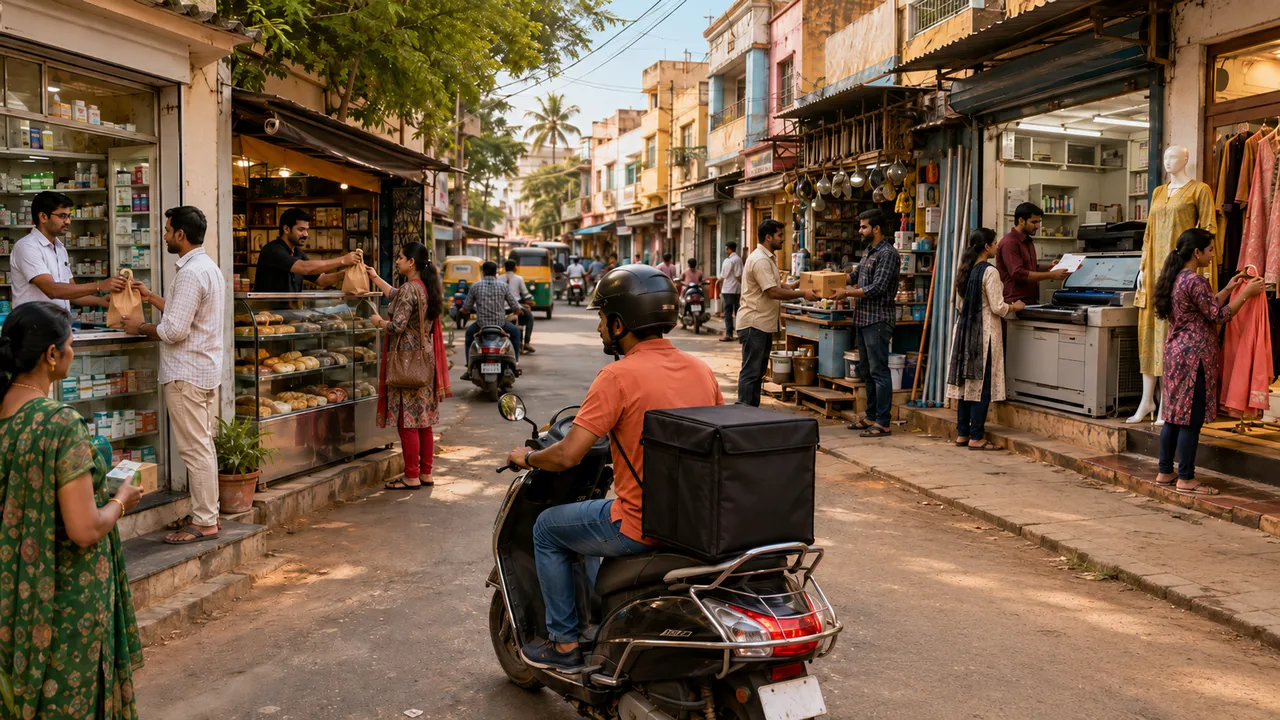
Much of the public discussion around instant delivery focuses on groceries. However, Tier-2 cities contain thousands of businesses that need to move many other types of items.
Examples include:
- A hardware store sending a missing component to a construction site
- A garage requesting an automobile spare part
- A printing shop delivering visiting cards to an office
- A boutique sending clothes to a customer
- A home baker delivering a cake
- A family sending documents or keys
- A pharmacy sending medicine to a nearby home
- A restaurant delivering a meal
These use cases do not necessarily require a warehouse. The product is already available at a local shop, office or home. The missing layer is a reliable method of moving it across the city.
Hubballi’s Business Environment
Hubballi serves as a major trade centre and is part of a district with activity across agriculture, food processing, garments, automobiles, manufacturing and technology. Its location between Bengaluru and Mumbai also contributes to its commercial importance.
This business diversity creates many short-distance logistics requirements. A manufacturer may need to send a sample. A retailer may need to fulfil a local customer order. A service company may need to move signed documents. A restaurant may need access to online food delivery without building its own fleet.
A local platform can bring these individual requirements into one shared delivery network.
Affordability Matters More in Tier-2 Markets
Tier-2 customers are often willing to pay for convenience, but the delivery charge must remain proportionate to the value of the item.
A customer may accept a reasonable charge for urgently delivering documents, medicine or a forgotten item. The same customer may hesitate when the delivery fee is close to the cost of the product itself.
Platforms must therefore improve operational efficiency instead of relying indefinitely on discounts. Better order matching, route calculation and use of a shared runner network can help control costs without placing the entire burden on customers, businesses or delivery partners.
Trust Must Be Built Locally
Local deliveries often involve personal or business-sensitive items. Customers need to know who is collecting the package, where it is located and whether it has been delivered.
App-based booking, runner details, status notifications and real-time tracking can make the process more accountable than sending an item through an unknown individual.
Zumy describes itself as a delivery facilitator that connects people who need to send something with local runners who can deliver it. Its platform uses maps, alerts and tracking while working with people familiar with the city.
This combination of technology and local operations is important in markets where trust is built through repeated, reliable service rather than brand advertising alone.
One Network, Multiple Local Uses
Building separate delivery networks for food, parcels and local transportation can lead to underused capacity. Each category has different peak periods.
Food orders may peak around meal times. Business parcel requests may arrive throughout the working day. Local rides may be concentrated around offices, colleges, markets and evening travel.
Zumy combines food, parcel delivery and Hop bike rides within one local app.
From an operational perspective, a shared local network can serve different types of demand across the day. For customers, it reduces the need to use separate platforms for common city movements. For local businesses, it creates access to delivery without requiring an internal fleet.
The Opportunity for Locally Built Platforms
Large national platforms have significant capital and technology, but local platforms can focus on problems that may be too specific or too small for a national operator to prioritise.
A local company can study neighbourhood demand, speak directly with merchants, adjust operating areas and build services around the types of items people actually move within that city.
This does not mean local platforms automatically succeed. They must still deliver reliable service, maintain customer support, balance pricing and build sufficient order density. Their advantage is the ability to make decisions around the city rather than forcing the city to fit a standard national model.
Building Delivery Infrastructure for Hubli-Dharwad
Hyperlocal delivery should be viewed as part of a city’s commercial infrastructure. It allows small shops to reach more customers, helps residents complete urgent errands and provides flexible earning opportunities to local runners.
Zumy is building this layer specifically for Hubli-Dharwad. Through parcel delivery, food ordering and local rides, the platform aims to make everyday movement within the city simpler and more structured.
The larger opportunity is not merely to deliver faster. It is to create a reliable local network through which businesses, customers and delivery partners can participate in the growing digital economy of Tier-2 India.